
How to Promote OnlyFans: Where to Start and Find Traffic
If you came here for a list of 50 ways to promote OnlyFans, I don’t have one. I build YouTube channels for OnlyFans creators, and I write about what we’ve actually tried on our projects.
What interests me about YouTube is that viewers have time to get familiar with a creator. Seeing her for a few seconds in a feed is one thing. Putting on her ASMR for 20 minutes before bed every night is another. Eventually, people come back for her, not just another video.
That’s why I’m putting more effort into building each creator’s public presence. We’ve tried using revealing content to get traffic quickly. It brought people to OnlyFans, but YouTube banned some of the channels for policy violations. We had to create new ones and build an audience all over again.
What we achieved
On one project, our YouTube links generated $4,255.58 on OnlyFans over four months. That’s the amount the tracker attributed to those links.
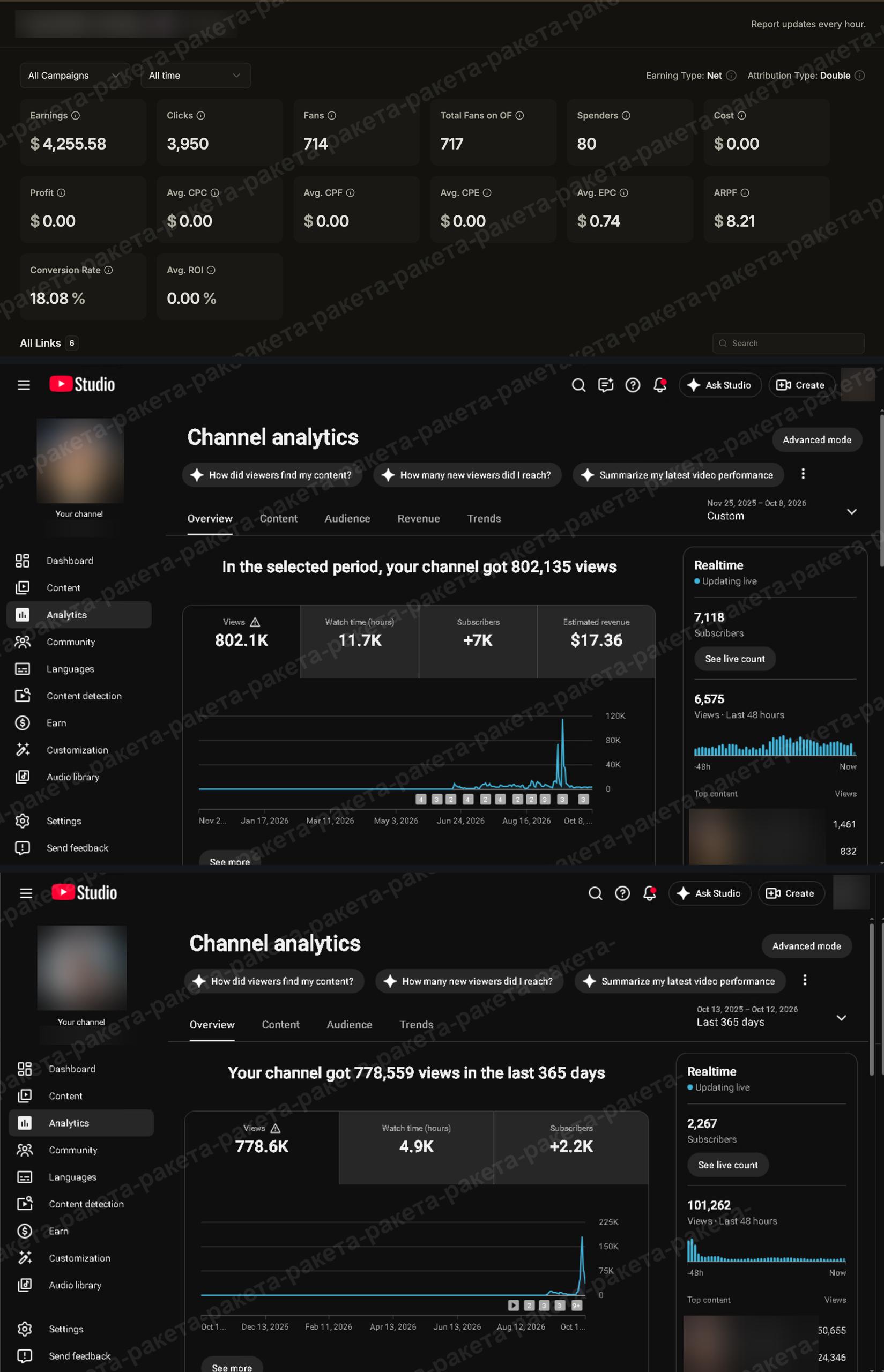
We also recently got one channel monetized. Monetization has only been running for a few days, so it’s too early to draw conclusions about earnings from YouTube itself.
$4,255 over four months isn’t a huge amount either. I’m showing the work as it is, including the results so far and the mistakes. I’ll keep sharing what we change and how it affects earnings.
On Telegram, I share updates as we try new formats.
Start with the creator
Before deciding where to get traffic, you need to understand what would make someone want to watch this particular creator.
Some people have a distinctive look. Others tell a good story or feel comfortable on camera. That gives you a starting point for a format that feels natural for her to film.
At the start, we talk about what she actually enjoys doing and what content she’s comfortable making. We also establish how much she’s willing to film. If you’re constantly short on footage, promoting her will be difficult, however good your plan is.
How we run several channels
Our creators have several YouTube channels, each with a different job.
We build the main channel for the long term. The creator puts time into filming, and we produce quality content that lets viewers get to know her as a person. We pay particular attention to YouTube’s rules so we don’t lose a channel we’ve invested so much in.
The other channels bring in traffic. We use them to test formats that are easier to produce and aimed at a broader audience. Some viewers go on to OnlyFans; others are directed to the main YouTube channel through end screens.
Those additional channels help generate clicks now while also bringing an audience to the main channel. That’s how we give the main channel a boost. Whether it works depends on how interested viewers are in the content they find when they get there.
We used to rely too heavily on quick, revealing content and lost channels to policy violations. Now the goal is to keep the multiple-channel setup while working within YouTube’s rules.
When people started coming through
We saw the first clicks after roughly a month of managing the channels. After that, a lot depended on how individual videos performed.
When a video picked up recommendations, noticeably more people came through. Traffic wasn’t consistent from day to day: one person might arrive today and a hundred tomorrow.
On this project, we liked the quality of the audience. People already knew the creator from her videos, which gave the OnlyFans team something to build a conversation around. What happened next also depended on how the team worked with them.
A high view count doesn’t tell you whether promotion is making money. You need to check that separately.
How to see where results come from
If you put the same link everywhere, it’s hard to tell which source worked. We use separate tracking links for different traffic sources and, where useful, for individual YouTube channels too.
That lets us see what a particular channel brought in and decide whether to keep putting the same resources into it.
For analytics, I recommend OnlyMonster. That’s my personal recommendation, not a sponsored placement. In a separate article, I’ll show how I use it and why I chose it, with screenshots.
Where I’d start
First, I’d settle on a format the creator is willing to film regularly. Then I’d agree on a realistic amount of work and set up a separate link to track results from the first uploads.
From there, you can publish videos and work out what’s happening. If you get views but hardly any clicks, look at who the content is attracting. If people reach OnlyFans but nothing happens after that, look at what they find when they arrive.
I chose YouTube because I see an opportunity to build a creator’s public profile over time. We have some initial results, but there’s still plenty to test. That’s what I’ll keep writing about.